https://mellet-consulting.com/publication/the-brand-university/How to make a sustainable, successful brand.
By Minter Dial & Eric Mellet
Executive Summary:
The world of branding has, over a very condensed period of time, undergone a virtual and very real revolution as far as both the consumer and the employee are concerned. The challenge that companies are now facing is how to adapt effectively and efficiently to several convergent paradigm shifts. This white paper reviews some of the major changes and raises questions about the implications for today’s leaders. This paper’s position is that, more than ever before, companies need to evolve into Learning Organizations and that instituting a company-wide Brand University can offer a compelling way to accompany such a change.
In today’s marketplace and, certainly, going forward, creating a sustainably successful brand has become a different and more complex task than in, even, the near past. The main factors that have brought about this shift are threefold: (1) the plethora of brands with the onslaught of new product launches; (2) the digital world (internet and mobility) with its ability to diffuse the power of traditional marketing and distribution; and (3) the latent lack of trust between the consumer and the brand, layered in with the lack of trust between employee and employer.
The consumer – certainly impacted by the economic pressures -- has pulled back from buying brands blindly. The luxury market, for example, has been distinctly hit, as there has been more scrutiny of the intrinsic value in the upscale prices. As Pam Danziger of Unity Marketing said in their 2009 study on the luxury market, “[a]ffluent consumers are redefining, reassessing and re-evaluating their lives and their lifestyles. This is happening across the culture, not just among a small segment of the affluent market and it will mean major shifts to how luxury brands can market their goods in the new economy.”.
Yet, the phenomenon of questioning the value of brands goes much further. In the current environment, with manifold uncertainties produced by the lingering threat of terrorism, global warming and economic recession, the consumer has been re-evaluating his/her relationship with money and the purchase decision in search of greater meaning. In order to rise above the strictly functional performance of a given product, the brand will need to demonstrate its “added value”, whereby the consumer finds significance in -- and identifies with – the brand’s values. And a large part of the challenge is in being able to communicate that value effectively and fluidly.
Brands have to fight through the clutter of crowded, confusing and disparate communication channels to reach an audience that no longer takes as the gospel the marketing messages. Broad and dislocated access to information – especially on price, performance and location – has empowered the consumer. With the so-called “left brain” messaging driven to its logical extreme, the new world order belongs increasingly to the “right brain” where image, emotion and experience are privileged – if only unconsciously -- by the consumer in their purchase decision. In this context, companies need to evaluate whether their employees are tapping into their more creative and conceptual side. In his book, “A Whole New Mind” Dan Pink forcefully speaks to the value of a balanced mind, combining the rational and analytical components with the more imaginative, artistic sides of the brain. And such is the need inside the new organization, which could be better described as a living organism, capable of learning, growing and adapting to the new environment and demands of the marketplace. As Peter Senge said, “[i]n the long run, the only sustainable source of competitive advantage is [the] organization’s ability to learn faster than its competition.”
If product excellence and innovation remain the sine qua non of leading brands, traditional Kotler-like marketing no longer carries the same weight in creating a successful brand. One could even argue that marketing, as we know it, must take a step back to re-allocate resources toward building the business the “old fashioned way,” that is to say via relationship and network building, aided by the burgeoning new technologies. As written by Minter Dial on TheMyndset.com:
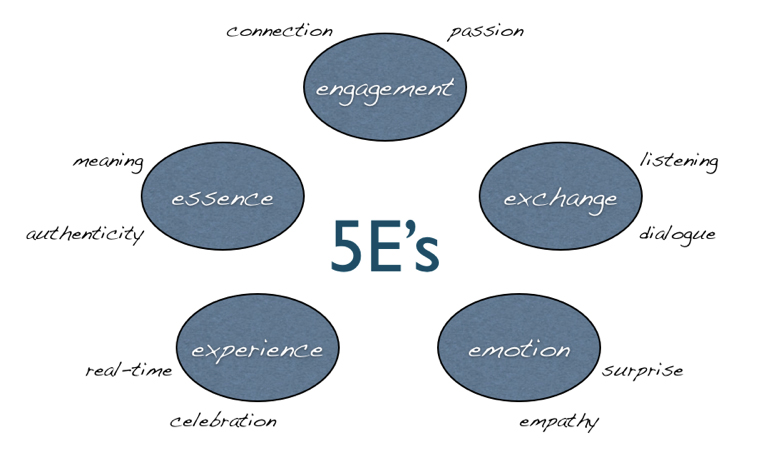
“The emphasis so often remains on the product, its performance, packaging, pricing and publicity — all part of a hardcore left brain (i.e. super rational) affair, with no room for fun or out of the box thinking. While marketing teams must continue to plot their 4 p’s, the real action is in words (i.e. accompanied by the authentic acts) that begin with an e: engagement, emotion, exchange, experience & essence. These 5 e’s come on top of the 4 p’s, not in replacement thereof.”
If social media has become so powerful, it is because it is “social” before it is media. The new business environment puts a greater emphasis on the quality of the relationship and other intangibles such as humor, education and the element of surprise. A successful brand, therefore, needs to create what Carl Rogers described as congruency as part of a larger value system. In a company setting, this value system requires time to develop and transmit and, by extension, requires a tremendous effort of coherency. Consequently, brands need to revisit their strategies and, importantly, need to rethink how to create an appropriate company-wide culture, with the adapted processes and tools.
At the centre of the equation is the human being, the employee, breathing life into the product experience every living day (and not just the working days). Brands interact with the customer in many inanimate one-way and interruptive manners, through advertising, packaging and merchandising. Such mechanisms will undoubtedly remain in place, albeit evolving with the new technologies. However, the strength of a brand – and its ability to retain a sustainable loyalty – will lie in the development of a dynamic and evolutionary relationship. Brands that will succeed in the future, therefore, will need to strengthen the emotional link – and this link passes most credibly via personal relationship building, networking and interaction. The key actor then becomes the employee. As Tony Hsieh, CEO of Zappos.com, has said, “every employee is the brand”.
And the main challenge in this context is being able to attract, select, train and empower the employee population to own, transport and transpose those values onto the end consumer experience.
The old moniker of “keeping it simple, stupid” remains pertinent, but not sufficient. The new world is radically more complex with evermore disperse, confused and crowded communication channels. A brand has to unify all its forces in the same direction in order to compete in this cluttered world. The strongest and most vibrant brands will be those that are meaningful and consistent, all the while being innovative. And there is no better vehicle to pass this message than via the employee. Some brands that have been doing an excellent job at this include Patagonia or Starbucks, while other high profile brands have actually taken to advertising their employees as their “product” (e.g. General Electric, IBM, Intel and, recently, Toyota). Whether that employee is the salesperson, beauty advisor at the department store stand, an educator for hairdressers, a customer service representative, telephone operator, or any junior employee in head office in an online chat room, the challenge is in spreading the values and galvanizing the entire organization behind the same tone of message.
For the vast majority of companies, the notion of brand building is rudimentary and limited to the development of product (or services) and filling of orders. Even when an enterprise is aware of the need to move from selling a product/service to creating an unforgettable experience. there are many hindrances to implementing a full brand experience. The ambition is oftentimes curtailed because of budgetary restraints, a lack of know-how or internal politics where departments operate too much in silos. And the challenge is not a simple one to overcome. At its core, the corporate culture may need to be re-conditioned to break down those silos and to allocate the time and resources necessary around the common uniting force: the client. And, in due recognition of the limited nature of resources, this will frequently entail what not to do as much as what is necessary to do.
In this new environment, companies need to evolve their corporate ethos and culture toward a style of management which favours collaboration intra- and, even, inter-company, to find ways to foster intra-departmental sharing of values and information, to harness the expertise and history resident in the individuals of the company via the new technologies. With the trend toward distributed workforces and the burgeoning wave of web-enabled technologies, there are opportunities – particularly for the larger multinational companies – to create blended (i.e. off- and online) networking and, equally important, blended learning environments. This suggests a host of new managerial skills and processes such as:
- A review of the brand’s strategy and an alignment of the brand’s strategy with its deeper mission (assuming such has been appropriately defined).
- The ability to define a corporate identity and culture, to clarify and share its values throughout the organization and to live fully by those values, i.e. to hire and fire according to these values.
- The need for new measurement tools for the organization which recognize a truly collaborative (“web 2.0”) spirit.
- A re-definition of the role of the manager as a coach or a facilitator (for example, of networks)
This raises 3 important questions:
- How to share the new brand identity – the vision – in order to get people to question outdated beliefs about what the company "is", and, ultimately, to change behaviours?
- How to create a [worldwide] network of trainers and/or consultants able to deliver the content and tools necessary to accompany such a transition?
- How to provide a sustainable, cost-effective presence in the countries to maintain the connection to and vibrancy of the brand’s values?
It is our conviction that one of the key methods of building a successful brand, that will have a sustainable future, is by creating a University for the Brand, an internally oriented organization which helps define those values within the enterprise. More importantly, this Brand University communicates those values via its partners and throughout the multiple channels and touchpoints toward the end consumer.
The Brand University would be, by our definition, a centre of creativity, innovation and collective intelligence. However, we believe the notion needs to go much further toward building a spirit, an identity and a community united around the brand. We believe that such a university must have three central principles to help create a sustainably powerful brand.
The first principle of the Brand University is that the company is genuinely dedicated to being client centric. Much lip service is paid to being client focused; however, many companies trip up under the sales pressure, overblown egos as well as a lack of means. To put the customer truly at the centre, a company needs to have the customer’s interests at heart. In order even to have access to those interests, the brand necessarily must gain the trust of that customer. As coined by Alex Mangossian, brands need to be less concerned with building their [internal] database and more concerned with building their fan base, through a relationship founded on trust. With that trust comes the opportunities to learn together, to collaborate and share invaluable data. Given the ability for consumers to circumvent or even to twist standard corporate communications, brands must learn to get involved with the customer in ways that are credible and, in short, more human. Customer Relationship Management (CRM) must be converted from a mechanical one-way conversation into social relationship building.
The second principle of the Brand University is that the strength of the brand resides in the human element. Employees up and down the age scale are increasingly seeking—above just straight compensation—greater meaning from their place of employment. It is well known that employee satisfaction can come from learning, providing instruction for purposes increased effectiveness and a degree of motivation. However, greater fulfilment can come from working in an ongoing learning environment. Well beyond one-time, off-site trainings, a learning environment implies more a shared state of mind. And, the coincidence is that companies need also to convert themselves into learning organizations in order better to capture the history and knowledge that resides in its human bank. A Learning Organisation is one in which the internal team is committed to a constructive and systemic approach of sharing and learning in the pursuit of a positive economic result. Importantly, the entire organisation must be involved and, fundamentally, the ‘corporate’ strategy, if not culture, must involve and encourage experimentation, learning and the “right to err”. As said by Pedler et al,
“[t]he Learning Company is a vision of what might be possible. It is not brought about simply by training individuals; it can only happen as a result of learning at the whole organization level. A Learning Company is an organization that facilitates the learning of all its members and continuously transforms itself.”
The third principle, in line with the generally accepted definition of the Learning Organisation, is that the Brand University must become a project-wide undertaking, not limited to the sales force or the other branches directly in touch with the end customer. Not only does the CEO need to be the brand’s biggest and best spokesperson, all departments need to be aligned behind the same values and messages.
We believe that the Brand University concept, that seeks to propagate the brand’s values and systems throughout the brand and all the subsidiaries, starting with the sales branch, is the most comprehensive and organic process, adapted to the modern challenge of multinational brands. The undertaking of a true Brand University for a major brand is as yet unprecedented on an international stage. While there are many corporate universities in existence, they tend to focus on competence acquisition or sales training. The Brand University, as the basis of a vibrant learning organization, remains untested in the field in its fullest measure. And for companies with a portfolio of brands to manage, the further challenge is creating an all-encompassing company-wide sales university without compromising or effacing the differences resident in each of the brands.
The very first step is critical: to establish that the company is ready and willing to evolve, with buy-in from top management. As is so often the case, top management must lead by example. Moreover, the allocation of resources is systematically a top-down decision belonging to the C-suite.
In order to avoid creating an empty concept, the starting point has to be operational, and close to one of the organization's nerve centres. This will allow the creation of a community of practice. The idea here is not a Corporate University, more often devoted to the development or the recognition of some Happy Few, but a real Brand University. This, by bringing together the various communities of practice, creates relationships, bonding the different stakeholders while embracing Brand values and thus creating a sense and pride of belonging. When it comes down to it, staff members are the first to create a positive energy around their Brand. And they are the first to share, contagiously, their enthusiasm, their confidence, and their pride in the products or services promoted by their Brand.
The Brand University is a real or virtual space in which staff can share codes, symbols, habits, behaviour, and language, and gain from cultural, generational, or even hierarchical diversity. It is a forum for the shared ideas, values, and especially the vision which are the bases of any "human company". A Brand University will thrive if the initial impulse is accompanied by the boundless capacity to encourage innovation, the sole guarantor of future value. Today, more than ever, innovation cannot come solely from R&D locked away in a laboratory, or from brand management pirouetting in its headquarters, but must instead be encouraged, sought after, supported, and recognised within all levels of an organisation. To return to the metaphor of a living organism, the survival of the organisation depends on a developmental intelligence and having adaptation skills built into every living cell.
From this perspective, the initial “community of practice”, as the starting point of the Brand University, allows us to come back to the fundamental professions associated with the common goal of production, whatever the industry. Organisations operate with increasingly complex structures. Multi-national companies create matrix hierarchies, cross-departmental projects, indispensable yet potentially stultifying rules, and seek economies of scale that can kill off good ideas before they get off the ground. In this world of ever more complex organisations, a return to the basics and the lowest common professional denominator is the best way to put the horse back before the cart and give a new impulse and energy to move forward. At the granular level, individuals are faced with the fragmentation of tasks and the emergence of often-misunderstood virtual tools (whose adoption is resisted). Combined with a fear of change, individuals experience isolation, stress, discouragement and disorientation. In this context, regaining confidence in "knowing what you know, doing what you do" and sharing it with others across professional and language barriers, are a source of enrichment and empowerment. Such empowerment gives back to employees the feeling of working together, pride in belonging, and peer recognition, all of which help lead to a renewed hope that difficulties can be overcome by individual initiative and collective mobilisation as well as a commitment to the values which bring them together: The Brand.
The Brand University should be a space in which everyone, whatever their position in the company, not only accepts change, but become actors who create change. They can experiment with new perspectives, open themselves up to new ideas, cut through traditional hierarchies or divisions to create new relationships, and act and talk differently in order to try out new ideas on a neutral terrain. The goal of the Brand University is to capitalise on shared knowledge and passion to find ideas that will, in the future, contribute to the organisation of the company, and especially to test how these discoveries can be implemented and integrated to become the new Business as Usual.
About the Authors:
- Minter Dial, President of The Myndset Company, based in Paris, France, is an international consultant and professional speaker on Branding and Digital Marketing, working with CAC40 and multinational companies in Europe and North America. Previously, he enjoyed a 16-year international career with L’Oréal, spanning 9 assignments in 4 different countries, including Managing Director Worldwide of the Redken brand for 4 years. In his last position with L’Oréal, he was a member of the worldwide Executive Committee, in charge of eBusiness, Education and Business Development worldwide for the L’Oréal Professional Products Division, out of Paris. Minter has two downloadable radio shows (on iTunes: Minter Dialogue and Minter Dialogue en français) and maintains a French blog at fr. He can also be reached at minter@themyndset.com or be followed on Twitter @mdial.
- Eric Mellet, based in Paris, France, is International Sales and Development Training Director.
“The Brand University” article was first published as a white paper on the BrandChannel, October 2010, and was also published on TheMyndset (23 October, 2010).